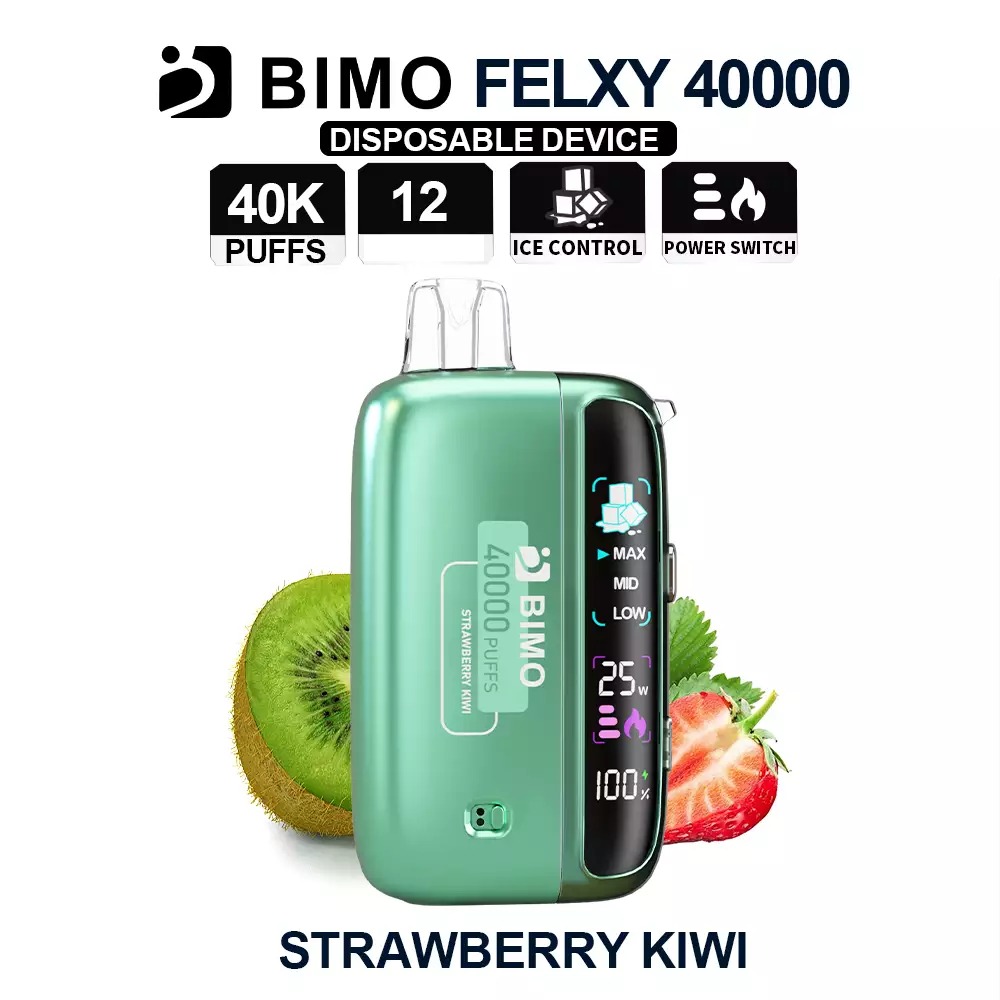

BIMO Felxy 40000 Puffs Strawberry Kiwi Disposable Vape Australia
Strawberry and kiwi together is one of the most searched taste combinations in this category, and it is also one where the search and the product do not quite line up. A lot of people look for this pair expecting it to arrive cold, because strawberry and kiwi is a combination people associate with chilled summer fruit rather than with a warm-tasting vape. This particular taste does not ship with any cooling in it at all. On most devices that would simply be a mismatch. On this one it is not, because the base has its own ice control, and understanding what that control does to this specific blend is the most useful thing on the page. It does something unusual, and it does not do the same thing to both halves.
Two hardware points first. What you hold here is a reusable power base into which sealed prefilled pods drop magnetically, which is why it connects to a charging lead at all and why the cooling, the output and the draw are all adjustable rather than fixed at manufacture. This listing is the Kit, which is the base plus one Strawberry Kiwi pod. A pod sold on its own has nothing powered inside it and will not run without the base, so if you have not bought this platform before, this is the listing that works.
Why people expect this pairing to be cold
Start with the expectation rather than the fill, because the expectation is reasonable and it explains a lot of what people find confusing about this option.
Strawberry reads as cold and wet. It is a soft, pale fruit that sits in cold things, and its aroma has a fresh wet quality that lines up naturally with something chilled. Kiwi does the same thing more strongly, since people usually meet it in sliced fruit drinks and in cold summer desserts rather than in anything warm. A blend of the two therefore inherits a cold association from both halves, and that is why the combination gets searched for with ice in the name far more often than a lot of fruit pairings do.
That expectation is not a misunderstanding on the buyer’s part. It is a reasonable reading of the combination. The only mismatch is that the fill itself does not carry any cooling, so on a device where cooling cannot be adjusted you either get the cold version or you do not, with nothing in between. That is the situation on a sealed disposable, and on this platform it is not, because you can set the temperature yourself after you have tasted the taste warm and worked out what you actually want.
So the honest position is this. The taste is not an iced taste as it ships. The base can make it a cold taste in four steps, at any point, and you can decide after tasting it. What matters is knowing what that dial costs you on this particular blend, because it is not a flat cost and it is not evenly spread across both fruits.
The ice control pushes the two halves in opposite directions
This is the thing that makes Strawberry Kiwi worth reading past the name on this device. Almost everywhere else in this range, added cold does one thing to the whole profile, whether that is pushing a delicate fruit back, softening a dryness, or reinforcing a drink. Here it splits the blend in half, because the two fruits respond to cooling in opposite ways.
On the strawberry half, added cold is close to an upgrade. Cold reads as extra freshness, and the strawberry half is built on fresh, wet, bright aromatic notes, so turning the dial up makes the strawberry more vivid and more like itself. That is why a chilled strawberry taste is such a well-liked thing, and this profile reproduces it well. On this side of the blend, the dial genuinely helps.
On the kiwi half, the effect runs the other way. What identifies kiwi is a sharp green aromatic character, and green and cold occupy the same part of what your mouth can perceive. They compete. Turn the ice up and the green note does not get sharper or brighter, it gets swallowed, because the cold signal is louder and lands in the same place. So on this side of the blend, the dial takes away rather than adds, and the higher you go the more of the kiwi you are paying away.
Put together, that means every position on the ice control is a different deal rather than a different strength. ZERO gives you both halves intact and a warm-tasting fruit blend. The low and middle positions give you a brighter strawberry with a kiwi that is starting to sit further back, which is a good version of this profile and probably the best compromise available. The top position gives you a genuinely cold, vivid strawberry drink, and by that point the kiwi is doing very little. That last version is a real and pleasant taste, and plenty of people will prefer it. What it is not is an iced version of the same taste. It is a strawberry drink with some kiwi in it.
That is the trade worth naming plainly, because it is not obvious and because the combination is specifically searched for in its cold form. If you are ordering this expecting the iced version of the taste people search for by that name, take a lower setting than you think you need. If you are after the cold strawberry drink on purpose, this device will give it to you at the top of the dial and you should not expect the kiwi to come with it.
The power control moves the balance in the other direction
Three settings at 15W, 20W and 25W on a 1.1 ohm dual mesh coil, and on this blend they work against the ice dial rather than with it.
The strawberry half is carried by volatile aromatic compounds, and more vapour spreads those across more air rather than concentrating them, so the strawberry gets quieter as the wattage rises. The kiwi half is different. It is not a scarce compound, and it is not volatile in the way the strawberry note is, so what happens at higher power is that the whole blend gains body and the strawberry recedes behind it while the sharper green half holds its ground.
So the wattage and the ice control push the same two halves in opposite directions to each other. Cold and high wattage both favour the strawberry, and both cost you the kiwi. That gives you a useful grid rather than a single recommendation, because you can also hold one up while you push the other down.
For instance, high ice at low wattage gives you a cold, vivid strawberry over a comparatively solid kiwi, which is the closest this device gets to the iced version of the combination without losing the second fruit. Low ice at high wattage gives you the reverse, a rounder and less sweet blend where the green half carries more of it. Fifteen watts is also the gentlest on fill per draw, so it buys the most sessions out of one fill.
Airflow decides whether you taste one fruit or both
The adjustment most people leave alone is doing the most useful single job on this profile, because this blend is about a relationship between two notes rather than about one note at two strengths.
Opening the base gives the volatile compounds on both sides more room to register before they clear, which brings the strawberry forward and gives the green kiwi note space to be heard at the same time. Closing it concentrates everything into a smaller volume, which makes the whole taste denser and louder but blurs the two halves into a single mixed note. Neither position is wrong, but they are genuinely different, and on a blend whose whole appeal is that one fruit rescues the other, they are not the same taste.
So the sensible order is to settle the ice control and the wattage first, since those two decide which fruit you have more of, and then use the airflow to decide whether you can hear both of them clearly. If the blend tastes like one fruit rather than two, the airflow is the thing to change rather than anything else.
What happens to this one as the pod empties
Because this taste is built on volatile aromatic notes rather than on body or sugar, it does not improve as it goes. There is no middle section waiting for you, and nothing to come back to later in the pod.
The specific pattern here is worth knowing, because it runs opposite to the heavier tastes in this range. As a pod works down, the strawberry note is the first thing to thin out, because it is the most mobile part of the blend. What is left is the sharper, greener half carrying more and more of the taste on its own. So a Strawberry Kiwi pod in its final days does not taste like a faded strawberry blend. It tastes greener and sharper, and closer to a straight kiwi than the name suggests.
That has a practical consequence for how you work through the range on this platform. Open this one while it is fresh if the combination is the point, and save the fuller, body-carrying profiles for later in the session when you want something that still reads the same. And if you are trying to judge whether you like this blend, do it on the first few draws of a new pod rather than at the end of one, because the end of one is a different taste from the one you ordered.
Strawberry Kiwi against the other profiles here
Fifteen profiles on this device. This is one of the lighter and less sweet directions among them, and the comparison that matters is with the other two-fruit blends rather than with the single fruits.
The comparison worth making is with the fruity drinks, because cold is exactly what they want and it is what this profile has to trade. If you are certain you want a cold vape and you are not attached to two distinct fruits, the drink directions will take the top of the ice control without giving anything up. This blend is the more interesting purchase precisely because the dial is a decision rather than a free improvement.
One honest limitation. Because cold competes with the green half, there is no way to get a fully cold strawberry and a fully present kiwi from this pod at the same time. That is a real constraint rather than a matter of finding the right setting, and it is worth weighing before you order if the kiwi is the reason you are looking at it.
Strawberry Kiwi specifications on the BIMO Felxy 40000
The forty thousand figure belongs to the platform rather than to the pod you are holding, so it functions as a comparison point when you are weighing this device against another one, not as a count on one fill. Your settings move the real number as well, since long slow draws at 25W use more fill per puff than short ones at 15W. The screen reports battery and wattage rather than remaining fill, so the signal that a pod has tilted is in the taste, where the strawberry shortens and the sharper green half carries more of the taste on its own.
Settings for this profile
Start at 20W with the dial at ZERO and the airflow open
Middle wattage, no added cold, and the most spread out draw so both fruits can be heard at once. Nothing is crowding anything else out at this position, so it is the honest place to decide whether this blend is for you before you start trading one half of it away.
Take the ice up only as far as you are willing to pay in kiwi
Low and regular give a brighter, more strawberry-forward version while the kiwi is still audible. The top of the dial produces a genuinely cold strawberry drink and pays for it with the green half. Decide which of those two you are ordering before you start turning, not after.
Drop to 15W when the strawberry is crowding out the green half
Less vapour concentrates what is there, which brings the sharper kiwi note forward relative to the strawberry. Pairing that with a low ice setting and open airflow is the closest this device gets to both fruits being fully present at once. Fifteen watts also uses the least fill per draw.
Open the airflow if it is tasting like one fruit instead of two
Spreading the vapour gives the volatile compounds room to register separately rather than blurring together. Closing it makes the taste denser and louder but merges the two halves. On a blend whose appeal is the relationship between the fruits, this is the control that decides whether you hear it.
Open the pod while the combination still reads as two fruits
There is no build-up phase in this profile, so the strawberry thins out from the first session onwards. Judge the blend on a fresh pod and drink it early, and save the body-carrying tastes in this range for later in the pod when you want something consistent.
Strawberry Kiwi questions buyers ask
Is this an iced taste?
Not as it ships. No cooling is built into this fill, which is worth knowing because a lot of searches for this combination include ice in the name. On a sealed device that would be a straight mismatch. Here the base has its own four-position control, so you can make it as cold as you want or leave it warm and decide for yourself.
Will turning the ice up give me the iced version of this option?
It will give you a cold, vivid strawberry with much less kiwi behind it, because cold and the green character of that second fruit compete for the same part of what you can perceive. So the dial gets you closer to a cold strawberry drink than to an iced two-fruit blend. The middle positions are the best compromise between them.
Is it sweet?
Much less than most of the fruit in this range. It is a bright, fresh blend with a sharp green half, and it reads as light rather than sugar-forward. If you are after something with real sweetness behind it, the creamy and dessert directions on this platform will suit you better, and they will also hold their shape better across a pod.
Why does it taste more like kiwi near the end?
Because the strawberry half is the most mobile part of this blend and it leaves steadily from the first session. What is left behind is the sharper, greener half doing all of the work. Nothing has been used up unevenly, you are simply reaching the point where the strawberry has thinned out ahead of the kiwi.
Which wattage should I use?
Fifteen watts if you want the kiwi forward and the pod to last longest, twenty-five if you want the fuller strawberry read, twenty as a sensible middle. On this blend the wattage and the ice control favour the same half of the blend, so holding one down while you raise the other is how you get a balance.
Can I order just the pod?
It is cheaper than a Kit and can be ordered on its own, but there is nothing powered inside a pod. Both cells, the connector, the readout and every control are part of the base, so a pod is only worth buying once you already have that base. A first order on this platform needs to be the Kit.
Buy disposable vapes in Australia
Strawberry Kiwi on the Felxy 40000 is the clearest case on this platform of a control being a decision rather than an improvement. The ice dial strengthens the strawberry and buries the kiwi at the same time, the wattage favours the same half in the same way, and the airflow is the one setting that lets you hear both. That means the right setting depends entirely on which of the two fruits you actually came for, which is a question listings usually do not help you answer. Every product page here describes what each control changes about that specific blend, separates the cooling built into the fill from the cooling you set yourself, explains how the profile shifts as the pod empties, and says whether the listing includes the hardware needed to run it. IGET, BIMO, ALIBARBAR, PICCO and ARVO are held together in one catalogue so profiles across device types can be compared on a single page, stock is kept and shipped within Australia, and a single unit is a normal order with no minimum.
Why SmokeOZ?
On a device with this many dials, the useful thing is not the number of settings but knowing what each one costs you, because on some blends every setting improves things and on others a setting can quietly remove half of what you bought. Each page here names that cost for the taste it describes, including where a control has to be traded against something else, and states plainly whether you are looking at the hardware with a pod or the pod by itself. Stock does not leave the country before it reaches you, a single piece is bought the same way as a case, and everything technical about the device is published next to what it costs.