


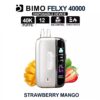
BIMO Felxy 40000 Puffs Triple Berry Disposable Vape Australia
The useful thing to know about Triple Berry is not that there are three berries in it. Every multi-berry blend tells you how many fruits are in it, and that number does very little work. What matters is that three is not a number of equal parts here. Two of the three fruits on this platform are close relatives of each other, and the third is not related to either of them at all, and it is built in a completely different way from the two. That arrangement has consequences for how this blend tastes, which part of it is fragile, and which dial on this device actually helps.
Two hardware points first. What sits in your hand is a reusable power unit with sealed prefilled pods dropping into it magnetically, which is why it needs a charging lead at all, and why cooling, output and draw are all settings rather than fixed choices. This listing is the Kit, which is the base plus one Triple Berry pod. A pod ordered alone has no power of its own, so it is only usable once a base exists, and a first order on this platform therefore has to be the Kit rather than the pod.
Two of the three are cousins, and the third is
Blackberry and raspberry are not two separate fruit ideas that happen to share a colour. They are very close relatives in a botanical sense, close enough that they sit in the same group, and their aroma profiles overlap heavily as a result. Both read as soft red fruit with a floral top, both are carried largely by a family of light fruity esters, and both have a similar sweet-to-sharp balance. If you tasted them side by side without being told which was which, plenty of people would struggle, and some would guess they were the same fruit.
Blueberry is not in that group. It is a different plant entirely, and it smells different for a reason that goes beyond the colour. Where the two relatives lean on light fruity esters for their character, blueberry leans on terpenes, and it leans on them at very low concentrations. The compounds doing the identifying in a blueberry are present at trace levels and are extremely powerful, which is why blueberry is such a difficult taste to build and why a weak blueberry often does not read as mild. It reads as nothing.
So Triple Berry is not three tastes averaged together. It is two closely related tastes plus one unrelated one, and the unrelated one is the most fragile part of the whole blend. That is the arrangement worth understanding, because it is what makes this profile behave differently from a blend of three things that have nothing in common.
Which means losing one of them makes the blend worse, not simpler
There is an expectation about multi-fruit blends that this one breaks. If you have three things in a blend and one fades, you would normally expect to be left with something simpler and easier to read, two distinct notes instead of three. That is not what happens here.
The two relatives in this blend are more like each other than either of them is like the third. So when the odd one out is the first to go, the two that remain are the two that were already the most similar. The blend does not simplify. It becomes crowded, because you now have two near-identical red-berry notes competing for the same space and nothing that distinguishes them.
This is worth knowing because it changes what a good version of this blend looks like. A triple berry where all three can be picked out is doing something quite difficult. A triple berry that has faded to two cousins is not a milder version of that, it is a muddier one. Which means the useful question about this profile is not how strong the berry is overall, it is whether the third fruit is still audible in there.
That is also why the odd one out is the first to fade rather than the last. Blueberry is carried on trace amounts of something very powerful, and those compounds leave steadily from the moment a pod is opened. The ester-built relatives do not have that problem in the same way, because esters are abundant and there are more of them, so losing some changes the blend without gutting it. The blueberry half loses the argument with the air first.
Both dials push the same way on this blend, and the fix is to use less of them
There is no cooling built into this fill, so all of the cold comes from the four-position control on the base. On most blends that control is a simple question of how much you want. Here it has a specific effect on which of the three fruits you can hear, and it is not a fair trade.
Added cool reads as extra freshness, and it also flattens the sharper aromatics while lifting the impression of sweetness. Both of those push the blend toward the two cousins and away from the fragile third fruit. The blue note in this blend is carried by exactly the kind of delicate aromatic that gets pushed into the background when perception is being pulled towards cold and sweet. So every step up the ice dial makes the triple berry read more like a double berry.
The wattage does the same thing for a different reason. More vapour spreads a scarce compound across more air rather than concentrating it, and the blueberry half of this blend is carried on scarce compounds while the two relatives are carried on abundant ones. So the relatives survive being diluted and the third fruit does not, and at the top setting you get a fuller, louder, redder taste with the odd one out almost gone from it.
Both controls agreeing on the same direction is unusual on this platform, and it produces an inversion that is worth stating plainly. If you want to hear all three berries, the change to make is not turning something up. It is turning something down. Staying at the bottom of the ice dial and the bottom of the wattage is how you keep the third fruit in the blend at all, and that is the opposite of the instinct that comes with a control-heavy device.
What the dials are genuinely good for here is a fuller, warmer, sweeter version of a double berry. If that is what you actually want, this blend will deliver it easily and it is a pleasant thing to vape. Just be clear that you are not getting a triple berry at the top of the dials, you are getting two cousins and the memory of a third.
Airflow points the other way, which makes it the useful one here. Opening the base gives the delicate compounds room to register before they clear, which is the difference between hearing a third fruit and losing it. Closing it concentrates everything into a denser taste where the two relatives sit on top and the third is buried. So on this profile the widest airflow setting is doing the most valuable work, and it is the control nobody adjusts.
What happens to this blend as the pod empties
This profile has a specific failure mode that is worth recognising early, because it does not look like a pod running out.
As the pod works down, the fragile third fruit drops out and what is left is the two relatives. Because those two are so similar, the result is not a simpler taste. It is a denser and more crowded one, and it is very easy to mistake that crowding for the blend just getting stronger. If a Triple Berry pod suddenly seems more intense than it was, that is the two cousins filling the space rather than the taste deepening.
There is also a seasonal dimension here, which is unusually relevant in Australia. Berries are not equally good for most of the year in this country. Their quality in a greengrocer moves through the calendar, and there are windows where the dark berries are at their best and windows where they are not. A blend built on two related red berries and one delicate blue one is going to be more noticeable when those fruits are actually worth eating and less convincing when they are not, and the profile does not carry enough weight on its own to cover for that.
The practical upshot is to drink this while the pod is fresh, and to judge it there. A triple berry is at its most worth buying in the first part of a fill, and that is the opposite of the fuller-bodied profiles in this range that reward you for saving them.
Triple Berry against the other blends here
Fifteen profiles on this device. This is one of the few built from three related things rather than two, and the comparison worth making is against the other berry blends rather than against the single fruits.
The comparison that matters most is against the two-berry blends, and the difference is instructive. In a two-berry blend the two fruits have clearly different jobs, so when one fades the survivor carries the taste on its own and stays readable. Here the two that survive are the two that were always hardest to tell apart, so the loss does not produce clarity. If you want a berry blend that stays easy to read across a whole pod, a two-fruit version is a safer buy than this one.
One honest limitation. There is no setting on this device that gives you three clearly separated berries, because two of them are closely related enough that separation is a property of the blend rather than something a dial can create. What the controls offer is the choice between a delicate triple berry and a fuller double berry, and the dial positions make that choice rather than refine it.
Triple Berry specifications on the BIMO Felxy 40000
Forty thousand is the platform rating rather than a description of the pod in your hand, so it works as a comparison point when you are weighing this device against a different one rather than as a count on one fill. Your settings move the real figure, since long slow draws at 25W use more fill per puff than short ones at 15W. The screen reports battery and wattage rather than remaining fill, and on this blend the signal that the delicate fruit has gone is that the taste reads as one dense red fruit instead of three, which is easy to mistake for strength.
How to get three berries out of a two-fruit blend
15W, ice on ZERO, airflow wide open
Every dial turned in the direction that protects the fragile fruit rather than the one that strengthens the blend. Least vapour keeps the delicate compounds from being diluted, no added cold stops them being flattened, and the widest airflow gives them room to register. That combination is the only place on this device where all three fruits are present at once.
If it reads as one fruit, widen the airflow before you change anything else
The problem on this profile is almost always the delicate third fruit being crowded out rather than the blend being too weak. Airflow is the only control that brings it forward, and it is the one people leave alone. Turn the base open and listen for the third note before you reach for the other dials.
Turn the dials up when you want a fuller double berry
Higher ice and higher wattage both make the two related fruits louder and warmer, and that is a genuinely good taste rather than a mistake. Just be clear about which of the two you are having, because the blend will not tell you and the name certainly will not.
Open the pod while it is still a triple berry
The delicate fruit leaves fastest, and what it leaves behind is the two fruits that were always hardest to tell apart. Drink it early, judge it there, and do not mistake a pod that has gone crowded for a pod that has gone strong.
Check the joining surfaces before fitting a new pod
A trace of residue across the magnetic contact is the usual reason a new pod seems not to seat properly. Wiping both contact surfaces dry takes a moment and removes the single most common small fault on this hardware.
Triple Berry questions buyers ask
Can I actually pick out three different berries?
At the lower settings with the airflow open, yes, and that is the version worth ordering for. Two of the three are closely related and genuinely hard to separate from each other, so the third is what makes a triple berry readable rather than a red mass. At the higher settings you get two of them clearly and the third barely at all.
Why does it taste more intense partway through the pod?
Because the delicate fruit leaves first and the two that remain are the two that were already the most similar, so they fill the space it left and crowd each other. A blend getting stronger is not what is happening here. It is two similar fruits competing for the room one used to occupy, which reads as intensity but is actually the opposite of clarity.
Should I run it hot or cold?
Low, if the reason you want a triple berry is the third fruit. Cold and high power both flatten the delicate note and hand the blend over to the two related fruits. High and cold is a fine way to vape a warm, sweet red berry, and it is not the way to vape a triple.
Is this an iced taste?
No cooling is built into the fill, so all of the cold comes from the dial on the base. That matters more than usual on this blend, because cold is what costs you the delicate fruit. Knowing you can turn it to nothing is worth something here.
How long does one pod last?
It comes down to how you run it. Forty thousand is the platform figure rather than one pod, and long draws at 25W use more fill per puff than short ones at 15W. The screen shows battery and wattage rather than remaining fill, so the signal is in the taste going from three fruit to one dense one.
Can I order just the pod?
A pod costs less than a Kit and can be bought separately, but there is nothing powered inside one. Both cells, the connector, the readout and every control belong to the base, so a pod only makes sense once you already have that base. Anyone without a base already should be looking at the Kit rather than at spare pods.
Buy disposable vapes in Australia
Triple Berry is the clearest example on this platform of a control that works in the direction opposite to the one you expect. The two related fruits are built abundantly and the third is built on trace amounts, so both the ice control and the wattage quietly hand the blend over to the louder pair as you turn them up. Hearing three berries means turning both down and opening the airflow, which is not a setting anyone would guess at without being told. Listings here describe what each blend is actually built from, which part of it is fragile, which control protects it and which one costs it, and whether the listing includes the hardware needed to run it. IGET, BIMO, ALIBARBAR, PICCO and ARVO are all kept in one catalogue so berry blends, drinks, citrus and dessert directions can be compared on the same page, stock is held and shipped inside Australia, and a single unit is a normal order with no minimum.
Why SmokeOZ?
On a device with this many dials, the important question is not what a setting does in general but what it costs you on the particular fill in the pod you bought, and those two things are often not the same. Every page here names what is fragile in a blend and which control costs it, so you are not paying for a stronger taste and finding out later that what you lost was the part you wanted. Stock is held in an Australian warehouse and dispatched from there, one unit is an ordinary order rather than a bulk commitment, and the specification and the price sit together on the same page.