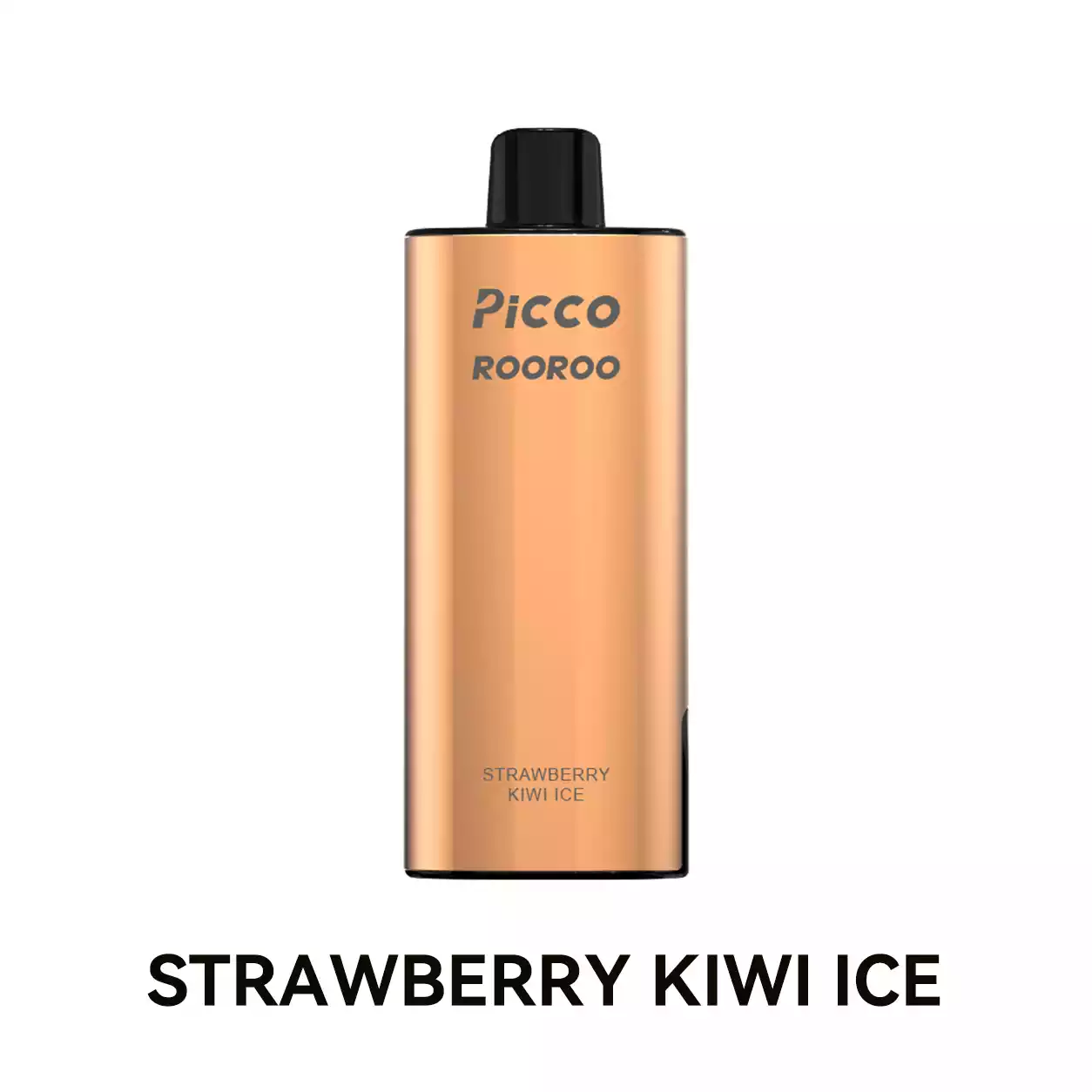


PICOO ROOROO 12000 Puffs Disposable Vape Strawberry Kiwi Ice
Most two fruit blends are built from two fruits of comparable strength, and what you get is something in between. This one is not built that way. The kiwi in it is one of the loudest fruits available and the strawberry is one of the quietest, and a blend that uneven does not arrive as a blend at all.
It arrives as a kiwi with a sweetness setting attached. That is the honest description, and it is the single most useful thing to know before ordering. The sections below explain why the quieter fruit disappears into the louder one, what the cold finish does to that imbalance, and how this profile compares with the other berry pairs in the range.
What This Device Provides Here
| Point | Detail |
|---|---|
| Rated puffs | Stated maximum of 12000 draws |
| Internal cell | 2500 mAh, supplied at full charge |
| Charging | No input on the housing at all |
| Display | Two readouts, for fill and for cell |
| Shell | Aluminium alloy body, 99.96 g empty |
| Length and width | 102.40 by 40.10 mm at the outer face |
| Adjustments | None fitted on this model |
| Not stated by the maker | fill amount, coil build and coil resistance |
Two Fruits of Very Different Volume
Every blend in this range that names two fruits gives the impression of equal parts, because the label does not carry weights and the buyer has no way of knowing any. So the reasonable assumption when you see two names is that you will taste two things. On this particular pair that assumption is wrong, and it is wrong for a reason that has nothing to do with how the blend was mixed.
It is worth separating two ideas that get run together. One is strong versus weak, which is about intensity. The other is loud versus quiet, which is about how much of the palate a fruit occupies on its own before anything else is added. A fruit can be comparatively mild in intensity and still be the loudest thing in the blend, simply because the other fruit is quieter still.
Kiwi is loud. Its acid is not a supporting note that a second fruit can sit beside politely. It arrives first, it registers as the main event, and it is still the thing you notice when the draw is over. Strawberry is quiet. Its sugar is its dominant half and its aroma is light, so strawberry tends to arrive as an amount of sweetness rather than as a fruit in its own right.
Loud fruit and quiet fruit are not the same as strong and weak
Two fruits can be blended at the same weight and still not arrive with the same volume. What matters is how loud each fruit already is before the other one is added.
Kiwi is one of the loudest fruits available. Its acid is not a background note that a second fruit could sit beside; it is the first thing the palate registers and the last thing it forgets.
Strawberry is close to the opposite case. Its sugar is the dominant half and its aroma is light, which means that when strawberry is present it tends to arrive as an amount of sweetness rather than as a fruit.
Put one loud fruit beside one quiet fruit at similar levels and the loud one keeps the identity. The quiet one becomes a setting on the loud one. That is not a blend, it is a fruit with a sweetness control built into it.
Put those two together and something predictable happens. The loud fruit keeps the identity, because identity goes to whatever the palate notices. The quiet fruit does not disappear, exactly, but it changes job. It stops being a taste and becomes a level. The difference matters more than it sounds: a taste can be judged on its own, while a level can only be judged as more or less.
Why the Quieter Fruit Stops Being a Fruit
Once a fruit has been demoted to a sweetness setting, there is no moment in the profile where it can be assessed. That is the part a buyer should sit with before ordering, because the expectation this label sets up is the thing that gets disappointed.
Compare it with a pair of quiet fruits. When two soft fruits are blended at similar volume they average out into a single soft voice, and that voice does read as a blend, because neither ingredient is large enough to take the identity alone. There is an option in this range built exactly that way, and it is worth trying if the goal is a smooth berry profile rather than a sharp one.
This pair is the structural opposite of that case. Because one side is loud and one is quiet, the loud side wins outright. What the buyer receives is a kiwi profile with a rounded sweet edge sitting under the acid, and the strawberry is not something you will ever pick out as a separate note while the acid is present.
The practical advice follows directly. If strawberry is the reason for the purchase, this is the wrong product, and the honest answer is the plain strawberry option in the same range. If what is wanted is an acidic profile with something rounding off the edge, then this does that job well, and it does it in a way almost nothing else in the range does.
There is a second consequence worth knowing, which only shows up later. Because the sweet half here is already the quiet half, the part that fades over a long sealed ownership is the same part that was barely audible to begin with. So this profile does not drift toward a different balance as it ages. It narrows. What was a kiwi with sweetness under it becomes simply a kiwi.
The Cold Makes the Imbalance Larger
This range contains a plain strawberry option where the same cold finish works in the buyer’s favour, and the reason is structural rather than accidental. On strawberry the sugar is the loud part, so a finish that takes sweetness off first is removing the thing that was too loud, and the fruit reads better afterwards.
Here the sugar belongs to the quiet fruit instead. The loud fruit here is the kiwi, and the kiwi is not sweet at all, so there is no sugar on the front of this profile for the cold to work on. What the cold reaches is the strawberry’s contribution, which is the quiet part, and taking it off leaves the acid with even less beside it than before.
So the ice word runs the other way in this blend. On the plain strawberry option it moves the profile toward the fruit. On this one it moves the profile further from the fruit and closer to plain acid. Both results come from the same mechanism acting on different ingredients, which is the reason the general rule is worth learning before choosing any iced option in this range.
There is a fair argument on the other side, and a buyer who prefers it should not be talked out of it. A reduced sweetness makes the acid cleaner and less cloying, so if the complaint about sharper fruit profiles is that they are too sweet to finish, this is the version that fixes it. The trade is that the fruit pairing becomes less of a pairing. Whether that is a gain or a loss depends entirely on whether the buyer wanted two fruits or one.
What the Hardware Leaves Fixed
Nothing about this profile can be adjusted. There is no mode selector, no airflow control, no power setting and no charging point, so the ratio between the acid and the sugar was settled before the device was packed and it will not move.
The draw is the only lever, and on this particular blend it is a weaker one than it is elsewhere in the range. A short draw lands more on the sharpness, because the sharpness is the loud part and the palate goes there first. A longer draw lets the cold finish spread further across the palate, which mutes the acid rather than bringing the strawberry forward. What it changes is intensity, not balance, and a buyer hoping to dial the sweetness back up by technique will not manage it.
The rest of the hardware is straightforward and worth stating plainly. The cell is 2500 mAh and ships at full charge, and there is nowhere to plug a cable in even if a buyer wanted to top it up partway through. The screen reports the reservoir remaining next to the charge remaining, and because the cell cannot be recharged, the fill figure is the one that decides when the device has finished. The body is aluminium alloy at 99.96 g empty, and at 102.40 mm long it is a substantial object rather than a slim one.
How This Pair Sits Against the Others
This range contains several two fruit berry profiles and they are not variations on one idea. How two fruits relate to each other depends almost entirely on how loud each one is before they meet, and the pairs below differ on exactly that point.
| Option | How the two fruits relate | Buyer it suits |
|---|---|---|
| This option | Kiwi keeps the identity, strawberry arrives as a sweetness level beside it. | A buyer who wants acidity with a rounded sweet edge under it. |
| The two-soft-fruit option | Two quiet fruits at similar volume, which average into one soft voice. | For a smooth berry profile with no single fruit in charge. |
| The two-dark-fruit option | Three names across two acid families, which reads dry and seedy rather than sweet. | For a tannic, grown-up profile with real dryness in it. |
| The plain strawberry option | A single sugar-heavy fruit with the sweetness pulled back by cold. | For strawberry judged on its own, without an acid fruit beside it. |
| The pineapple and kiwi option | Two fruits that share a volatile and separate on acid, so the blend has layers. | For tropical structure rather than for a rounded sharp edge. |
Working Out This Strawberry Kiwi Blend
Will I actually taste both fruits in this one?
Not in the way you would taste two comparable fruits. Kiwi is one of the loudest things in the whole range and strawberry is one of the quietest, so the acid sets the identity and the strawberry arrives as rounded sweetness underneath it rather than as a separate fruit. If your reason for buying is the strawberry, read the plain strawberry option instead, because in this blend there is no point at which strawberry is the thing being tasted.
Is it sharper or sweeter than the strawberry and kiwi blend elsewhere?
Sharper, and the reason is the ice word rather than the fruit names. The sugar in this blend belongs to the quiet fruit, and a cold finish takes sweetness off faster than it takes aroma off. With the sugar reduced the kiwi has even less to compete with, so the same cold that makes a plain strawberry taste more like fruit makes this one taste more like acid. If you prefer the sweeter reading of the two fruits, take the version without the ice word.
Does the cold finish taste of mint or herbs?
No herb is named in this profile. The cooling is a plain cold finish with nothing herbal identified in it. Buyers who want a blend with a clearly recognisable mint character should choose a product that names it rather than inferring it from the word ice.
Can I bring the sweetness back up by drawing differently?
Not really, and this is worth being straight about. There is no selector, no airflow control, no power setting and no charging socket, so the ratio between the acid and the sugar was fixed before the unit was packed. A shorter draw lands more on the sharpness because that is the loud part, and a longer draw gives the cold finish more of the palate, which mutes the acid rather than bringing the strawberry forward. The draw changes intensity, not balance.
Which of the two fruits fades first over a long fill?
The strawberry, and quite noticeably. The acid is the durable half here, which is unusual because in most fruit profiles the sweet half is the one that outlasts the aroma. On this blend the strawberry is already the quiet half to begin with, so as it recedes the profile simply becomes more plainly a kiwi profile. Expect the fruit identity to narrow over a long sealed ownership rather than to stay put.
Buy disposable vapes in Australia
This is the most uneven pairing in the range, and the practical thing to take from it is that the label over-promises and the fill delivers. Kiwi keeps the identity, strawberry arrives as a sweetness level under it, and anyone buying for the strawberry should look at the plain strawberry option instead. What this one is good for is a clean sharp profile with the sweetness pulled back, because the cold finish reaches the sweet half and leaves the acid standing on its own. Expect the profile to narrow as the fill goes on rather than to hold its balance, since the quieter fruit is also the one that fades. Nothing on the device adjusts, so the draw changes intensity only, and a longer draw is the way to take the edge off without losing the fruit.
Why SmokeOZ?
Choosing between two fruit options is mostly a question of which one you actually want, and that is harder to work out from a label than it should be. Everything listed here is described against the hardware it really has, so a sealed 2500 mAh unit with no adjustment at all can be compared honestly with a rechargeable one or one with a slider before anyone commits to a full case of a profile they may not enjoy.
The names Australian buyers actually ask for, among them IGET, BIMO, ALIBARBAR, PICCO and ARVO, all sit in one catalogue here, and each product page sets out what the device does rather than how it ranks against a rival.
There is no account to open and no order minimum above a single piece, so one device costs the same to order as a full case and nobody has to buy in bulk to test a taste. Stock sits in Australia and ships from an Australian warehouse, which keeps the delivery domestic, and the low pricing is the standing setup rather than a temporary promotion. Both of those hold because the supply chain behind them has been in place for years.
See the PICOO ROOROO 12000 Puffs Strawberry Kiwi Ice at SmokeOZ