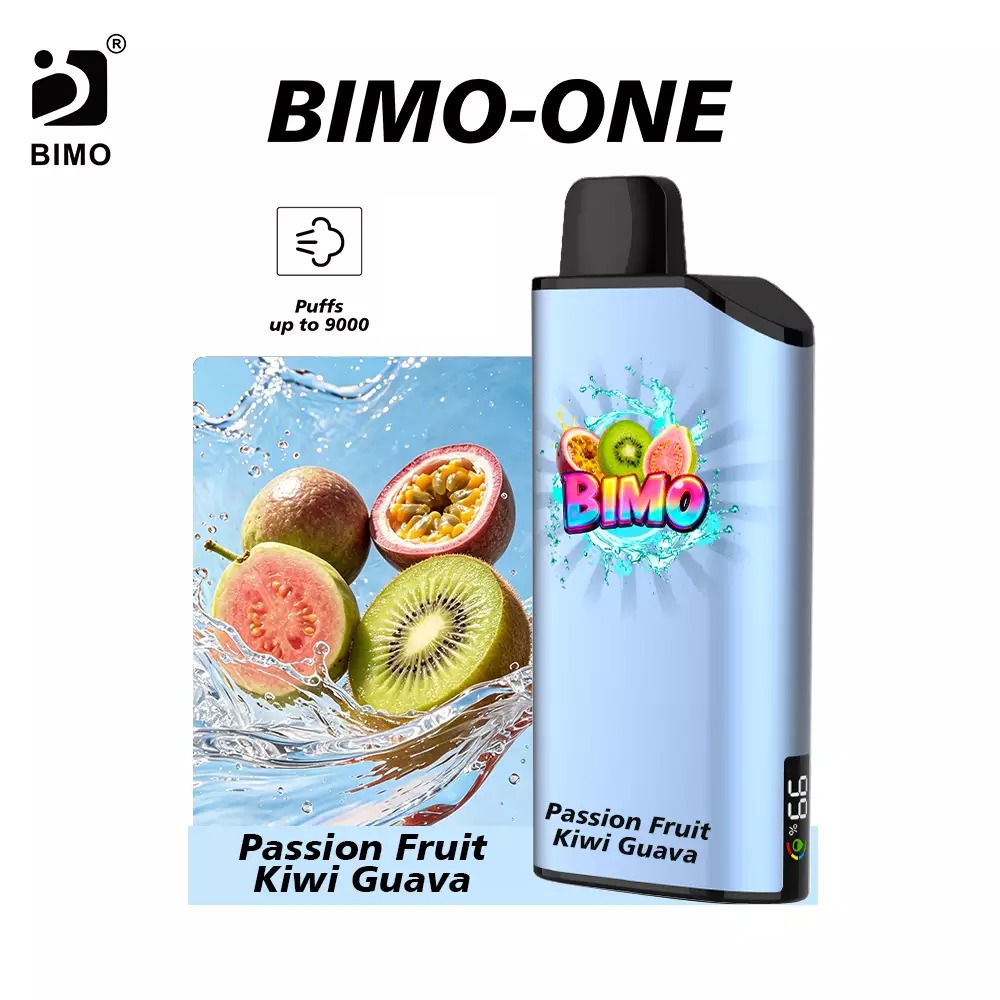
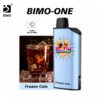
BIMO ONE 9000 Puffs Passion Fruit Kiwi Guava Disposable Vape Australia
Three fruits in one option looks like generosity. In a single fill it is closer to a balancing act, because a blended taste cannot give each fruit its own turn. What it can do is pick an overall direction and let one of the three lead it. On this blend the leading fruit is not the one most people would guess from the order of the name, and the reason is a piece of chemistry that makes passion fruit the odd one out among fruits generally.
The BIMO ONE 9000 Passion Fruit Kiwi Guava is a non-rechargeable disposable rated at up to 9000 puffs, with a sealed 22ml fill, a built-in 2500mAh battery, a 1.0 ohm coil and an integrated digital screen, and it is one of 17 options in the range. It is a tropical build with no cooling added. What follows is what each of the three fruits is actually contributing, and where a three-fruit tropical blend is most likely to go wrong.
One of these three fruits does not behave like a fruit at all
Nearly every fruit you can name announces itself with the same kind of molecule: a light aromatic compound of the sort that also turns up in flowers and in other fruits. Strawberry, mango, peach and melon all work this way. Passion fruit is one of the exceptions. The compound that gives it its unmistakable character belongs to a different chemical family entirely, one built around a sulfur atom, and that family is why passion fruit smells nothing like a peach even though both are soft orange fruits full of pulp.
You already know that family from somewhere else. The same group of compounds sits behind the sharp, bright edge of grapefruit, the distinctive tang of blackcurrant, and the smell of a tomato leaf rubbed between your fingers. It is a family with a very particular quality: it reads as intensely fresh and succulent when there is barely any of it present, and it turns strange and un-fruity very quickly once there is too much.
Why the useful range is so narrow
This is the part that makes passion fruit difficult to blend with. Compounds in that family are extraordinarily potent. The amount needed to give a fill a full, ripe passion fruit character is tiny, which means the gap between too little and too much is small as well. Underdose it and the fruit reads flat and vague, which is a disappointment but not a disaster. Overdose it and the taste stops reading as tropical fruit altogether and starts reading as something harder to name, closer to a sharp green edge than to a fruit you would eat.
Fruits built on the ordinary aromatic compounds do not have this problem. Push a strawberry or a peach too far and you get a stronger strawberry or a stronger peach. Push passion fruit too far and you get something that is no longer obviously a fruit, which is why it is the ingredient in a blend that has to be placed with the most care rather than the one you add for volume.
The smallest ingredient is doing most of the work
That potency leads to something genuinely counter-intuitive about a blend like this one, and it is worth understanding before you judge the taste. The fruit that contributes the least fill to the mix is often the one you notice most. Because the passion fruit note is so concentrated in effect, the amount needed to make it the leading character of the blend is small relative to the guava and the kiwi sitting underneath it.
The practical consequence is that you cannot work out the recipe from the taste. It would be natural to assume that the fruit you notice first is the one there is most of, and on a blend built from ordinary fruit aromas that is roughly true. Here it is not. If passion fruit is doing most of the shouting while being the smallest part of the mixture, then a taste that tastes strongly of passion fruit has not been built the lazy way. It has been built by getting a very small quantity of a very powerful ingredient right.
It also means the balance of a blend like this is far more sensitive than it looks. Move the passion fruit up by a small amount and you change the whole taste rather than nudging it, which is why a triple built around this fruit is a more difficult thing to land than a triple built around three mild fruits.
What the guava and the kiwi are carrying
The other two fruits are not decoration and they are not there to make up the numbers. They are the reason a blend with a volatile lead fruit stays drinkable.
Guava is the soft one. It brings a rounded, sweet, gently fruity middle note that is much less sharp than either of the fruits around it, and it is the part giving the blend its body. Without something sweet and soft underneath, a passion fruit note has nothing to sit on, and the taste ends up bright and thin rather than full.
Kiwi is the fresh one, and it is doing a specific job here. Passion fruit and guava are both fruits you mostly meet as nectar, pulp or a tropical blend rather than as something you eat off a board, so a taste built from those two alone drifts towards tasting like a carton of tropical drink. Kiwi is the one of the three you meet as fresh fruit, and its slightly tart, green edge is what keeps the blend on the fresh side rather than the nectar side. It is also why the taste finishes clean instead of settling into a sweet, rounded softness.
Where a tropical triple goes wrong, and what that tastes like
There are only a few ways a blend like this can miss, and each of them comes from one of the three fruits being given more room than it can use. Knowing what each failure tastes like makes it much easier to tell whether what you are tasting is a mistake or just a direction you do not like.
| Which fruit has too much room | What you taste instead | What the blend should taste like |
|---|---|---|
| Passion fruit | The tropical character disappears and the finish turns sharp and green, closer to a leaf than to fruit. It reads as harsh rather than ripe. | A full, ripe tropical opening, a soft sweet middle, and a clean green finish, with the three fruits reading as one register rather than as three separate tastes taking turns. |
| Guava | The taste goes flat and perfumed, sweet all the way through with nothing to lift it. It tastes like a soft drink that has been left open. | |
| Kiwi | The green edge takes over and the tropical fruit is pushed to the back. Fresh, but thin, and the sweetness never fully arrives. |
The useful thing to take from that table is that none of these failures is a matter of the taste being too weak or too strong overall. All three happen at the same intensity. What changes is which of the three fruits has been given the most room, which is why a blend like this is judged on balance rather than on strength.
Passion Fruit Kiwi Guava specifications on the BIMO ONE 9000
| Puff rating | Up to 9000 puffs |
| Taste | Passion fruit, kiwi and guava blended as one tropical profile, no cooling added |
| Capacity | 22ml sealed, pre-filled |
| Battery | Built-in 2500mAh, non-rechargeable |
| Coil | 1.0 ohm |
| Display | Integrated digital screen showing battery level and remaining capacity |
| Activation | Draw activated, no buttons |
| Range | One of 17 options in the BIMO ONE 9000 line |
Passion Fruit Kiwi Guava questions buyers ask before ordering
Can you taste all three fruits separately?
Not as three separate things, no. A three-fruit blend this concentrated is built as one tropical register, so the fruits arrive together. What you can pick out is the order of the impression: a strong tropical opening, a softer sweet middle and a clean green lift at the end.
Which fruit is strongest in it?
Passion fruit leads, and it does so without making up most of the mixture. Its character comes from a compound family that is far more potent than the aromas behind most fruits, so a small amount of it carries a long way. Expect the tropical opening first and the other two to fill in behind it.
Is it a sharp taste or a sweet one?
Both, in that order. It opens bright and tropical rather than sugary, softens through the middle where the guava does its work, and then lifts again at the end on the green side of the kiwi. It does not stay sweet from start to finish the way a candied fruit taste does.
Does it have any cooling in it?
No. There is no Ice or Frozen marker in the name and no menthol in the build. The freshness you notice comes from the fruit itself, which is worth knowing if you have been comparing it with the chilled options in this range.
How does it compare with the other tropical blends in the catalogue?
This one is the widest of the tropical blends here. The passion fruit and mango option is sweeter and leans on citrus to provide its lift, and the kiwi and pineapple combination is considerably more tart with no soft fruit underneath. This blend sits between them, with a sweet middle that neither of those has.
Buy disposable vapes in Australia
Passion Fruit Kiwi Guava on the BIMO ONE 9000 is a tropical blend led by the fruit whose character comes from a compound family far more potent than the one behind most fruit aromas. That is why passion fruit dominates a mixture it forms only a small part of, and it is why this taste is judged on balance rather than on strength: the blend fails when any one of the three fruits is given more room than it can use. SmokeOZ sets out what each fruit is contributing and how the finish behaves rather than leaving it to the name, and lists the device detail beside it, including the puff rating, the sealed capacity, the battery, the coil and the screen. BIMO, IGET, ALIBARBAR, PICCO and ARVO sit in one catalogue so the tropical options across the range can be compared together, one device is a normal order with no minimum, and the price shown is the price you pay.
Why SmokeOZ?
With three fruits in the title there is no way to tell from the name which one is leading the blend, and the fruit that leads is usually the one present in the smallest amount rather than the amount you would guess. Listings here say what each part of a blend is doing and where the finish lands, so a tropical mix can be judged on its balance before it is bought, and the device specification stays on the same page as the price. Stock is held within Australia, one device can be ordered without a minimum, and nothing is added on the way through checkout.