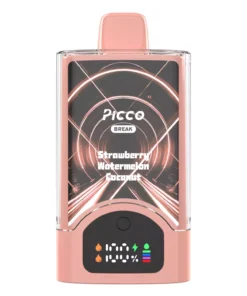
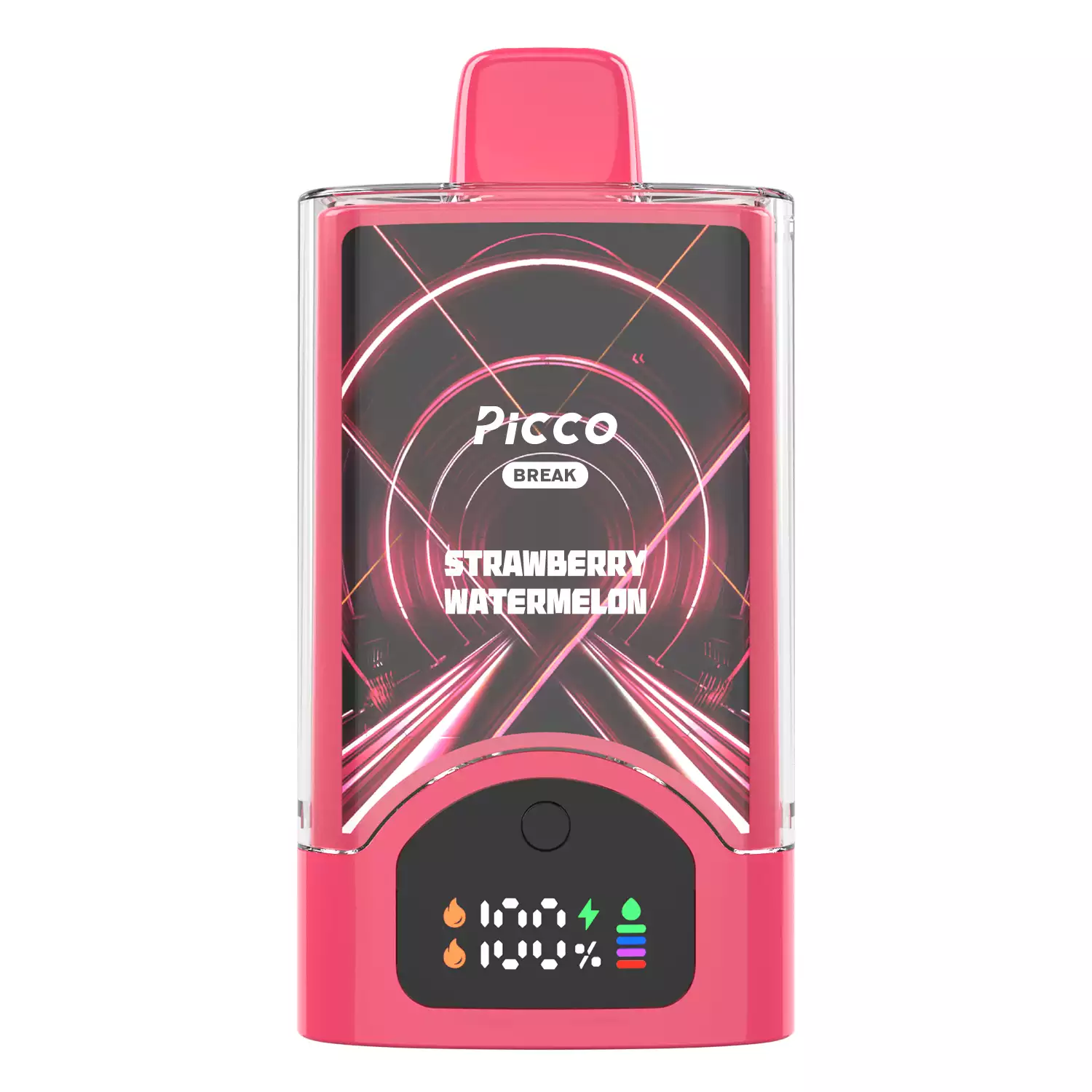
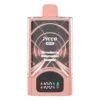
PICCO Break 30000 Puffs Disposable Vape Strawberry Watermelon
Pairings in a fruit range usually read as two halves sharing the work. Strawberry Watermelon is not built that way. A watermelon is mostly water and water carries no aroma of its own, so the melon half of this blend contributes a light sweetness and a sense of wetness while the strawberry half supplies nearly everything a buyer actually smells.
That uneven split explains most of what this page goes on to cover. It explains why the blend carries no cold layer when most watermelon blends do, why it reads softer than an iced version of the same pairing, and why the output range on this device matters more here than it does on a denser fruit.
What This Device Runs On
| Feature | Measure |
|---|---|
| Maximum draws | 30000 on Norm, closer to 20000 on Boost |
| fill inside | 25 ml, factory filled and permanently sealed |
| Cell capacity | 1300 mAh |
| Recharging | Through Type-C, with no lead supplied in the box |
| Output | Twenty watts at the bottom, thirty five at the top |
| Mesh | Quad mesh coil between 0.3 ohm and 0.6 ohm |
| Core toggle | Three presses move between Dual and Quad Ceramic Core |
| Screen | Two figures, charge and fill, on a single display |
| Weight | About 55 grams |
| Range | Twenty blends in the PICCO Break 30000 series |
Which of the Two Fruits Is Doing the Work
A watermelon is around nine tenths water. What a person recognises as watermelon is a small quantity of aromatic material sitting in a very large quantity of fill, which is why the fruit smells faint at room temperature and far stronger the moment it is cut open and the surface area goes up.
A strawberry is the denser of the two by a wide margin, and it brings something else that a watermelon does not. It carries a little acid. That small amount is what gives a fruit blend its shape, because acid cuts sweetness and clears the palate between draws, and without it a recipe has nothing holding the sugar back.
One fruit carries the aroma
A watermelon is around nine tenths water, and water carries no aroma of its own. What a person recognises as watermelon is a small amount of material sitting in a great deal of fill.
A strawberry is the denser of the two by a wide margin. It has no single defining compound, but it does carry the small amount of acid that gives a fruit blend its shape.
Put together, the split is not even. The strawberry supplies the smell and the shape, and the watermelon supplies the water and a light sweetness behind it.
Why This Blend Has No Cold and Does Not Need One
Most watermelon blends in Australia are sold with a cold layer attached. The reason is structural rather than fashionable. A watermelon brings very little aroma and almost no acid, and ice is what gives a profile like that something to stand on. Take the cold away from a melon on its own and there is not much left.
This blend does take it away, and it gets away with it because of the strawberry. The red fruit supplies both the aroma and the small amount of acid, which means the recipe has a shape of its own before any cooling would be added. The practical result is a softer, less sharp reading than an iced version of the same two fruits, and a blend that suits a buyer who finds cold finishes tiring over a long fill.
Watermelon and the Green Edge
Every fruit note has a direction it fails in, and the direction a watermelon fails in is green. Pushed too far, or heated too hard, the materials that read as fresh melon start to read as raw and slightly vegetal instead, closer to the pale part near the rind than to the middle of the fruit. It is the most common complaint about melon blends and it is usually a heat problem rather than a recipe problem.
A strawberry has a faint green line of its own as part of its construction, so on this pairing the two halves can lean the same way at once if the device is run hot. That is worth knowing, because the fix is simple and free: drop the output and the green recedes.
The Wattage Range on a Watery Fruit
This device covers 20 W to 35 W, and three presses of the button move it between Dual Ceramic Core and Quad Ceramic Core. On a dense fruit that range is a genuine choice, because more heat brings out more material. On a watery one there is less material to bring out, so the upper half of the range has comparatively little to offer and a clear risk attached to it.
The sensible position for this blend is therefore low. Around 20 W to 24 W on Dual Ceramic Core keeps the melon sweet and keeps the strawberry clear. Going up to Quad Ceramic Core and toward 35 W makes more vapour, but the extra volume comes from a fruit that has very little aroma to give, so what grows is mostly warmth, and the green edge is what tends to arrive with it.
What a Large Fill Does to a Light Blend
Twenty five millilitres is a long way for one device, and a light watery recipe behaves differently over that distance than a heavy one does. Because there is so little aromatic material to begin with, any loss is felt sooner, and the blend will read quieter toward the end of the fill than at the start rather than changing character. Buyers who notice this usually find that dropping the wattage a little brings the top end back.
Where Strawberry Watermelon Sits in the PICCO Break 30000 Range
This is the lightest of the red fruit options and one of only a handful in the line with no cooling. The table below sets it against the other melon entry, the other strawberry entries, and one dense tropical so the contrasts are clear.
| Taste | How it is built | Who tends to want it |
|---|---|---|
| Strawberry Watermelon, the page you are on | A strawberry note over a watery melon base, with no cold layer and only a little acid holding it up. | A buyer who wants a light everyday fruit with nothing sharp in it. |
| Lychee Watermelon | The same melon paired with a perfumed fruit instead of a red one, which moves the whole blend toward fragrance. | For scent and water rather than a soft red fruit. |
| Strawberry Banana | The same strawberry set over a heavy body instead of a watery one, and much fuller in the mouth than this. | When the strawberry should sit on weight rather than on water. |
| Strawberry Kiwi | The same strawberry with a green fruit on top rather than a melon underneath, and brighter than this by some distance. | If the strawberry needs an edge to it. |
| Mango Ice | A dense tropical sweetness with cold holding the weight down, which is the opposite construction to this blend. | For richness rather than lightness. |
Questions About the PICCO Break 30000 Strawberry Watermelon
Is this the same as a strawberry watermelon ice?
No, and the difference is the whole point. Most watermelon blends on the Australian market carry a cold layer, because a watermelon brings very little aroma and almost no acid of its own and the cold is what gives it a shape. This one has no cooling at all and gets its structure from the strawberry instead, which supplies both the aroma and the small amount of acid. The result is softer and less sharp than an iced version of the same pairing.
Which of the two fruits is stronger?
The strawberry, and it is not close. A watermelon is mostly water and water carries no smell, so the melon half shows up as a light sweetness and a sense of wetness rather than as a distinct taste. Buyers expecting two equal halves tend to be surprised by this, and buyers who already know they like strawberry tend to be pleased by it.
Why does it sometimes read green or slightly vegetal?
That is the direction a watermelon note tends to fail in, and heat is usually what pushes it there. The materials that read as green and slightly raw are more noticeable at higher temperatures, so a buyer who picks up a vegetal edge should drop the output rather than assume the blend is wrong. Running below about 24 W on Dual Ceramic Core keeps the melon on the sweet side of that line.
What setting works best on it?
Lower rather than higher. A watery fruit has less aromatic material to lose, so extra heat has little to add and a fair amount to spoil, and the green edge described above is the usual result of pushing it. Around 20 W to 24 W on Dual Ceramic Core gives the cleanest reading of both fruits, and Quad Ceramic Core at the top of the range tends to flatten the melon out.
What arrives with the device?
The unit itself, prefilled with 25 ml and sealed, and nothing else. A Type-C lead has to be found separately, and one is needed because a 1300 mAh cell will not take a fill this size to the end on a single charge. The display reads out the remaining fill next to the remaining charge, so both can be checked before leaving the house.
Buy disposable vapes in Australia
What is worth deciding before ordering is whether a soft unchilled blend suits, because this one is built that way on purpose. There is no cold layer, the strawberry is doing most of the work, and the melon is there for lightness rather than for taste. Buyers who want cold with their melon should look at an iced option in the wider catalogue, and buyers who want a melon that actually smells strongly should look at the lychee watermelon. Running this device low is what keeps the green edge away.
Why SmokeOZ?
A pairing is rarely an even split, and knowing which fruit is carrying the recipe is the fastest way to tell whether a listing will taste the way a buyer is picturing it.
Nothing is hidden behind a trade account here. One unit can be ordered on its own, stock is held in Australia and leaves an Australian warehouse, and the pricing comes from a supply chain that is already established rather than from a short promotion.
The catalogue covers IGET, BIMO, ALIBARBAR, PICCO and ARVO in one place, and each listing carries the figures that decide how the device runs, so a light unchilled melon can be compared with a heavy iced one without leaving the page.
Order the PICCO Break 30000 Puffs Strawberry Watermelon from SmokeOZ