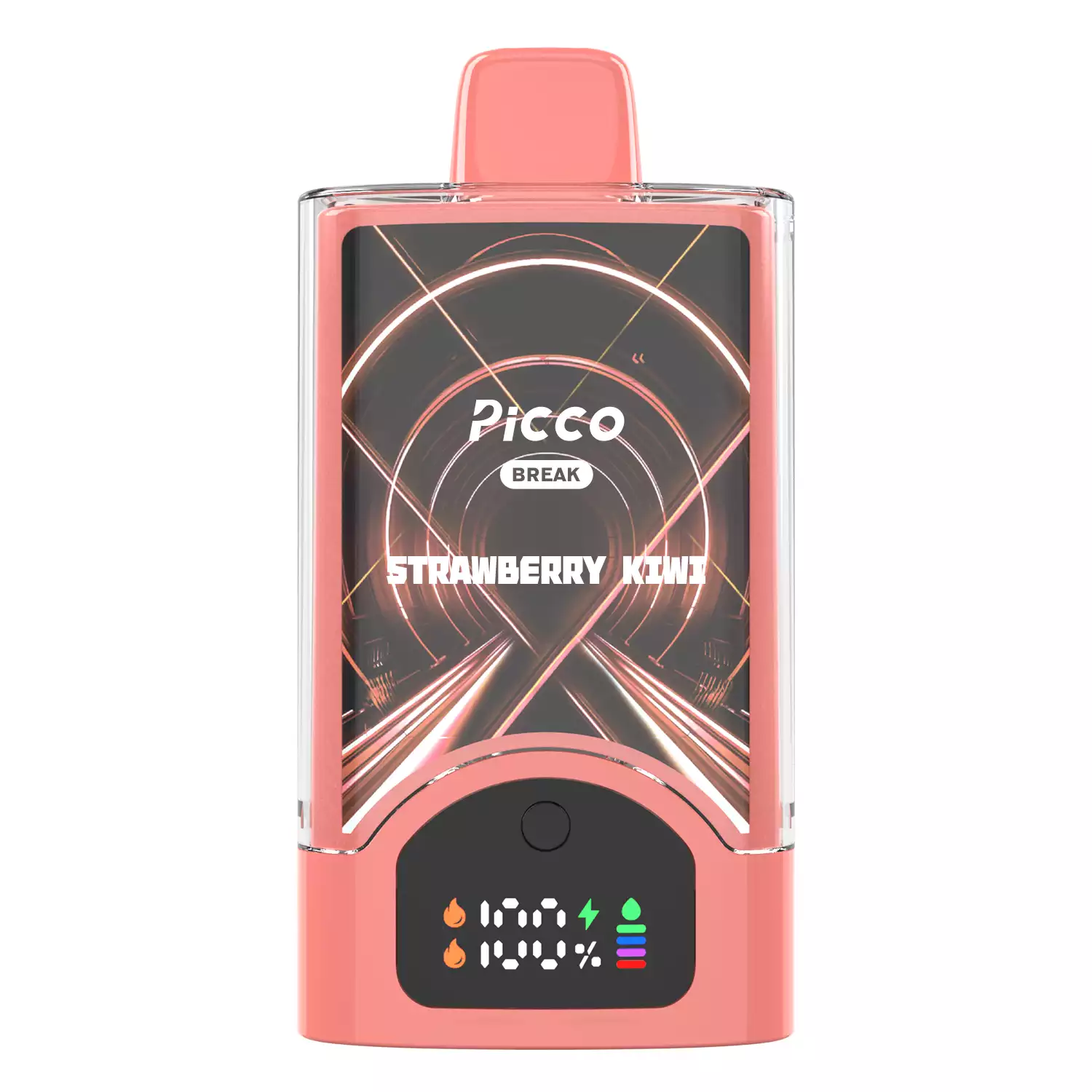
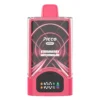
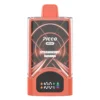
PICCO Break 30000 Puffs Disposable Vape Strawberry Kiwi
The two fruits in Strawberry Kiwi are not built the same way, and that asymmetry is the one thing worth knowing before buying it. A kiwi is defined by a single green aldehyde, one compound doing most of the work, while a strawberry has no equivalent and is assembled from several groups of materials instead. The practical difference is that one half of this blend is fragile and the other half is not.
That sounds like a small piece of chemistry and it turns into a real buying instruction, because it means the output setting on this device does the opposite of what most people expect. Turning the power up to get more kiwi removes the kiwi. The rest of the page covers why, what the green note is actually contributing, and where this blend sits next to the others in the line.
Specifications for This Unit
| What | Number |
|---|---|
| Quoted puff count | 30000 on Norm, about 20000 once Boost is used |
| Reservoir | 25 ml put in at the factory and sealed shut |
| Power cell | 1300 mAh, brought back up over Type-C |
| In the box | The device only, so the charging lead is down to the buyer |
| Power setting | Selectable between 20 W and 35 W |
| Coil build | Quad mesh, running 0.3 ohm to 0.6 ohm |
| Core choice | Dual Ceramic Core or Quad Ceramic Core, three presses apart |
| Readout | Charge percentage and reservoir percentage on the same screen |
| Tastes in the line | Twenty in total |
Two Fruits Measured on Different Scales
Fruit tastes are not all the same kind of construction. Some rest on one dominant compound that most makers aim at, which means versions of that option tend to agree with each other. Others have no such anchor and have to be balanced by hand, which means two versions can both be honest and still land in different places.
Kiwi sits firmly in the first group. A single green aldehyde carries most of what a person recognises about it, and it does so at very low concentrations, which is why the note reads as sharp rather than as heavy. Strawberry sits in the second. There is no one molecule that says strawberry, and what a maker puts together to stand in for it is a recipe decision.
One sharp line and one broad base
A kiwi rests on a single green aldehyde. One compound carries most of what a person recognises about the fruit, and it is a light material that heat strips out early.
A strawberry has nothing comparable. Its character is spread across several groups of materials that have to be balanced, which is why one strawberry blend can differ a great deal from another.
So the two halves answer heat differently. The narrow green line is fragile and the broad red base is not, and that difference is what the output setting on this device works on.
Why Turning the Power Up Does Not Give You More Kiwi
This device runs from 20 W to 35 W and most buyers assume the upper end means more of everything. On this blend it does not. The aldehyde carrying the kiwi is a light material, and the more heat goes into a draw the faster it is driven off, so raising the output strips the green edge out and leaves the broader strawberry standing on its own.
The way to hear more of the green note is the reverse. Sit near the bottom of the range on Dual Ceramic Core, keep draws on the shorter side, and the volatile material survives long enough to register. Moving to Quad Ceramic Core and up toward 35 W is not wrong, it simply produces a different blend, one that is rounder and sweeter and considerably less green.
Short Draws and Long Draws
Draw length works on the same principle as the wattage setting, and it is the control a buyer has on every device rather than only on this one. A short draw gives the heat less time to work on the light materials, so the green line arrives intact. A long draw holds the coil hot for longer, and the narrow note is the first thing lost. On a blend where one half is fragile and the other is not, draw length is effectively a way of choosing which fruit you are buying.
The Sharpness Here Is a Smell, Not a Sour Taste
The bright quality people notice in a kiwi does not come from acid. It comes from the aroma, which is why a kiwi reads as sharp even though the fruit itself is not especially sour. That distinction matters for how the blend behaves over a long fill, because an aroma that sharpens a profile is not doing what an acid does.
Acid cuts sweetness and clears the palate between draws, which is what keeps a sharp fruit blend readable at the bottom of a large reservoir. A green aromatic note does neither. So this blend stays soft underneath while the bright edge comes and goes, and the sweetness is never really cut back the way it would be on a genuinely acidic fruit.
What Changes From One Listing to the Next
Because the kiwi half has a clear target, the variation between two blends carrying this name shows up almost entirely in the strawberry. That is the half a buyer should read about when comparing listings, and it is also the half most likely to fade first over a long run, since the broader base is built from heavier materials than the green line on top of it.
The device gives a buyer two ways to work with that. The wattage range and the core selection both change how much heat goes into each draw, and the reservoir readout on the display makes it possible to notice when the profile starts to shift rather than assuming something has gone wrong with the unit.
Where Strawberry Kiwi Sits in the PICCO Break 30000 Range
This is the lighter of the two kiwi options in the line and one of the few blends with no cooling. The table below sets it against four others, including the other kiwi entry and the other strawberry entry, so the differences are easy to see.
| Taste | How it is built | Who tends to want it |
|---|---|---|
| Strawberry Kiwi (this listing) | A broad soft fruit base with one narrow green line over it, and no cooling in the recipe. | A buyer who wants a familiar soft fruit with something bright on top. |
| Kiwi Passionfruit Guava | The same green fruit placed among two tropical ones, so the sharpness has company rather than standing alone. | When the green note should be part of a crowd. |
| Strawberry Banana | The same strawberry used as the detail over a heavy body instead of over a bright one, and softer than this by a distance. | For the strawberry half without the green edge. |
| Blueberry Kiwi | A darker berry under the same green fruit, which pushes the green note further forward than it sits here. | If the kiwi should be the louder of the two. |
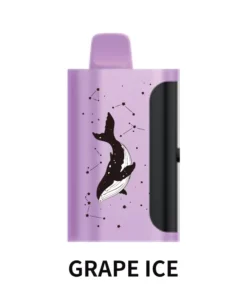
| Grape Ice | A single dark sweet fruit with cold holding the sugar back, and the furthest option here from anything green. | For depth and cold rather than brightness. |
Questions About the PICCO Break 30000 Strawberry Kiwi
How strong is the kiwi in this?
Present but narrow. A kiwi note is carried by one light green compound rather than by a broad group of materials, so it reads as a bright edge on the strawberry rather than as an equal second fruit. Buyers hoping for a green fruit to dominate should look at the blueberry kiwi in this range, where the same note has a darker and quieter partner under it and therefore comes through further.
How do I get more of the green note?
By turning the power down rather than up, which surprises people. The material that carries kiwi is light and volatile, so extra heat removes it early in the draw and leaves the broader strawberry behind. Around 20 W to 23 W on Dual Ceramic Core is where the green line survives best, and shorter draws help as well, because a long draw gives the heat more time to work on it.
Is there any cooling in it?
No. This blend has no cold layer at all, and it is worth saying plainly because the word ice appears in several names across this range and buyers reasonably assume it is standard. Everything bright about this one comes from the green fruit, not from a cooling agent.
Why does this taste different from a strawberry kiwi I bought before?
Almost certainly because of the strawberry. A kiwi note has one clear target, so makers land in similar places on that half. A strawberry has no single defining compound, so the balance of materials behind it is a recipe decision, and two makers can both be describing the same fruit honestly and come out with different results. That is the half to compare between listings.
What do I need to run it?
A Type-C lead, because the device takes 25 ml sealed reservoir and a 1300 mAh cell will not see that through on one charge, and no lead comes in the box. The fill itself is sealed in at the factory and cannot be added to. The display shows both the charge level and how much fill is left, which is worth checking before a long day out.
Buy disposable vapes in Australia
The one instruction worth carrying away is that less power gives more kiwi here. The green note rests on a single light compound that heat removes first, so the lower end of the range on Dual Ceramic Core is where it survives, and shorter draws help as well. Buyers who want the green fruit to dominate should take the blueberry kiwi instead, and buyers who want the strawberry half without any brightness on top should take the strawberry banana.
Why SmokeOZ?
Two fruits in one name are rarely built the same way, and knowing which half is fragile is the difference between getting the blend a buyer wanted and getting half of it.
Each device here is listed with the controls it actually has, so a blend that wants low power can be told apart from one that rewards turning it up. IGET, BIMO, ALIBARBAR, PICCO and ARVO are all in the same place for that comparison.
A single unit is enough and there is no trade account to open. Stock is held in Australia and orders leave an Australian warehouse, so the delivery is a domestic one, and the pricing reflects an established supply chain rather than a short campaign.
Order the PICCO Break 30000 Puffs Strawberry Kiwi from SmokeOZ